Where should you go for thermal baths in Germany? There are more than enough options. Germany has many spa towns, and in a number of them you will find truly impressive, modern and often very extensive thermal complexes that rank among the best in the world in many respects. If you prefer places like these to the more intimate, traditional or historic-feeling thermal baths found, for example, in Hungary or Slovakia, do not hesitate to take a trip to Germany. Many of the best thermal baths in Germany are also located close to the Czech border.
Best thermal baths in Germany
1. Bad Füssing – 3 huge thermal complexes
Our tour of German thermal baths could not begin anywhere other than the Bavarian town of Bad Füssing, a true Central European spa mecca. Although it has only a little over 8,000 inhabitants, it is home to three thermal spa complexes.
These are certainly not small, insignificant spas, but very extensive sites that rank among the largest in Germany. Bad Füssing naturally has official spa-town status and is an important tourist destination. It takes about four hours to drive here from Prague, while visitors from South Bohemia have the advantage of having this spa paradise almost on their doorstep.
In addition to the three spas, the town is full of hotels and hotel resorts. Many offer their own large wellness centres and spa clinics. There is certainly no shortage of varied accommodation and spa services. Let us now look at what each individual spa complex in the town offers. Each deserves attention in its own right.
Accommodation in Bad Füssing: If you want to walk straight to the thermal baths in your bathrobe, Hotel Holzapfel is very practical: it is directly connected to Therme Eins and Saunahof by the covered Thermenpassage and also has its own thermal pools. Johannesbad also has its own hotel group—Hotel Königshof, Thermalhotel Ludwig Thoma and Hotel Füssinger Hof. Thermalhotel Ludwig Thoma even has its own thermal pool supplied with water from the Johannesquelle spring.
Therme Eins complex

The spa complex known as Therme Eins, or “Thermal Baths One,” is only about 150 metres from the centre and town park. As the name suggests, it is the oldest spa in the town. Its story began in 1938, when an exploratory borehole one kilometre deep revealed a sulphurous mineral thermal spring at around 56°C.
After the Second World War, an improvised bathing area was created here and the healing power of the local water was discovered. Construction of a proper spa then began in 1958. It has, of course, undergone numerous renovations and expansions to reach its present form.
Today, Therme Eins treats rheumatic diseases, cardiovascular problems, metabolic disorders, gynaecological complaints and postoperative conditions. Its therapeutic scope is therefore very broad, and people also come simply to rest, relax and regenerate in the health-giving water.
The outdoor bathing area includes a round thermal pool, a swimming pool, a recreational pool, a whirlpool and a relaxing thermal garden. Altogether there are 12 pools and 2,500 m² of water.
The indoor area offers many more pools in beautiful surroundings. Another highlight is the excellent wellness centre and exceptionally extensive sauna world. Its “sauna courtyard” has a historic, rustic style dominated by wood. There are thermal and cooling pools and, above all, a very large number of varied saunas, all stylish and charming. It is literally paradise for sauna lovers. The spa naturally also offers wellness services, spa treatments and medical clinics. You can eat in one of the restaurants. In short, nothing is missing.
Therme II complex (Europa Therme)

The second spa in Bad Füssing is known as Europa Therme. It lies about half a kilometre from Therme Eins and is probably the second-largest spa complex in Bad Füssing as well as one of Bavaria’s largest thermal resorts.
The complex is very modern and has 17–19 indoor and outdoor pools, depending on whether the therapeutic pools are counted, with more than 3,000 m² of water.
There is once again an extensive wellness centre with a sauna world covering more than 1,000 m². It contains three dry saunas, several steam, herbal and aromatic saunas, a Russian sauna and much more.
The outdoor area offers around ten pools, including a 120-metre current channel, a large swimming pool, a hydromassage pool, a pool with underwater music, whirlpools and more. Further thermal and therapeutic pools are located indoors. Naturally, there is also a restaurant and café.
Europa Therme is highly rated and genuinely beautiful. It will appeal if you enjoy large pools and plenty of water, as well as extensive wellness facilities and services. One unusual speciality is its unique salt tower with sea air.
Therme III complex (Johannesbad)
The final spa complex is Johannesbad, situated slightly away from the town centre and built-up area amid greenery. Again, it is very extensive and is usually described outright as the largest in Bad Füssing. The water surface alone covers around 4,500 m², which is considerable. There are 13 thermal pools.
The setting is especially beautiful, with a more colourful and slightly more playful character than the previous two complexes. The many trees and green spaces are a definite advantage. Artificial rocks decorate the outdoor bathing area, while attractively shaped pools offer various interesting features, although there are no typical aquapark elements such as water slides or large chutes.
The outdoor area includes a rocky salt lagoon, a current channel more than 100 metres long, a swimming pool, counter-current pools and much more. Indoors you will find thermal pools, a wave pool, whirlpools, hydromassage pools and baths. The extensive wellness centre contains Roman baths, dry saunas, a Turkish bath, steam baths and relaxation zones. It is an excellent place for rest and regeneration.
2. Therme Erding

The town of Erding lies less than 40 kilometres northeast of Munich. The journey from Prague takes a little under four hours, and it is definitely worth making. This otherwise fairly inconspicuous town is home to thermal baths and an aquapark that rank among the largest and most unique in the world.
Therme Erding is a true water paradise, comparable in imagination, size and exclusivity to theme parks such as Legoland or Disneyland, only in an aquatic and tropical form. Visitors from the Czech Republic can consider themselves lucky that it is relatively easy to reach and not very far away.
The gigantic Therme Erding water complex has both indoor and outdoor areas. Its buildings are almost entirely glazed, creating a futuristic impression. As the saying goes, no expense was spared. Both the interiors and exteriors are astonishing. Instead of feeling as though you are somewhere near Munich, you might imagine yourself in a Caribbean bay. The water world is decorated with around 300 real palm trees and numerous artificial rocks and other details evoking a pirate and tropical atmosphere.
This water world is divided into several themed zones. Across more than 185,000 m², however, you will find around 40 pools, 28 water slides with a combined length of almost three kilometres, and more than 35 saunas and steam baths. The water in every pool comes from a thermal borehole 2.3 kilometres deep. It is simply fantastic.
A trip to Therme Erding will be an experience especially for families with children and playful adults, but thanks to the enormous wellness zones there is also more than enough space for relaxation and romance.
Accommodation at Therme Erding: Hotel Victory Therme Erding stands directly inside the complex and is styled like a large sailing ship moored beside a palm lagoon. Guests enter the thermal baths directly from the hotel lobby and, as a bonus, can enjoy an early morning swim in the wave pool before the complex opens to the general public.
3. THERME Bad Wörishofen

Another exceptionally beautiful, tropical-style thermal spa is located near Bad Wörishofen in southwestern Bavaria. From the Czech Republic it is a little farther—more than five hours from Prague—but it is still hardly an astronomical distance and is well worth a trip.
Bad Wörishofen’s thermal baths are slightly smaller and less spectacular than those in Erding, but the setting is at least equally enchanting. Everything is refined down to the smallest detail and every corner exudes exclusivity. This is also much more a spa than an aquapark: an oasis of peace, rest, regeneration and health.
Here too you will find indoor and outdoor areas. The indoor complex is dominated by the main hall, which is almost entirely glazed and even has an opening roof. Its interior is designed as a tropical paradise with palms, lagoons, coves and islands. The outdoor area, meanwhile, is dominated by a large natural lake directly connected to a pool.
The spa has an excellent wellness centre with a sauna world, so no wellness or spa service and facility is missing. It is an excellent place for peaceful bathing, romance and relaxation.
The main Thermenparadies and Vitalbad areas are normally for visitors aged 16 and over, except on selected family dates.
Accommodation at Therme Bad Wörishofen: The thermal baths do not have their own hotel, but they cooperate with several hotels in Bad Wörishofen. One of the main partner hotels is the four-star Hotel Tanneck on a quiet edge of town, which also offers its own wellness facilities.
4. Obermain Therme

Obermain Therme is located by the spa town of Bad Staffelstein, about 60 kilometres north of Nuremberg. The shortest drive from Prague takes roughly four hours, making it relatively close again, especially for people from western and northwestern Bohemia.
The spa impresses with its immaculate, precise and beautifully stylish setting. It feels very pleasant and peaceful, almost intimate, yet surprises with its size. This is a generous complex: the 25 pools alone cover around 3,000 m².
Wood plays a major role in the spa’s architecture, giving it a pleasantly warm character. The overall impression slightly evokes a Japanese Zen garden, reinforced by the presence of natural lakes that are also suitable for swimming.
The selection of pools and baths is genuinely varied, and most are filled with salty thermal water. The spring is unique because its salt concentration is so enormous that the water has to be desalinated for use in the pools to around 3.5%, equivalent to seawater. One special pool even reaches 12%.
Accommodation at Obermain Therme: The best choice is Best Western Plus Kurhotel an der Obermaintherme, connected to the spa by a covered bathrobe corridor. The hotel has 136 rooms and complements the thermal baths with its own VITUS SPA; higher room categories include admission to Obermain Therme and the hotel wellness area in the room rate.
5. Kristall Palm Beach Stein

On the outskirts of Nuremberg lies the town of Stein, whose attractions include the large Kristall Palm Beach aquapark and spa. This water world uses water from an underground thermal spring more than 300 metres deep. It is a centre of entertainment as well as relaxation, regeneration and health; skin diseases and musculoskeletal problems in particular are treated here.
The aquapark offers many different indoor and outdoor pools with a wide variety of attractions. There are more than 13 water slides, the longest measuring around 170 metres. You can look forward to a wave pool, lazy river, swimming pool, whirlpools and hydromassage pools, as well as an excellent and particularly large sauna world and wellness centre with beautiful outdoor saunas and other facilities. Thanks to its balanced combination of fun and relaxation, children and adults alike will love this spa.
Accommodation at Kristall Palm Beach: The complex itself has no hotel. The nearest official partner, Biohotel Kunstquartier, is approximately 800 metres from the thermal baths.
6. Therme Bad Griesbach

Wohlfühl-Therme is a rather smaller thermal spa, but it forms part of the remarkable and truly massive Bad Griesbach spa resort. The setting of this artificial spa “town”—in effect a network of spa hotels, facilities, wellness centres, pubs and restaurants—is actually charming and unique. The entire resort with Wohlfühl thermal baths stands in open countryside by Bad Griesbach im Rottal, about 20 kilometres from Passau and therefore very close to the Czech border.
The spa draws thermal water with a high fluoride concentration from a borehole 1,522 metres deep. Its 16 pools, covering roughly 1,600 m², provide room for relaxation, regeneration and various activities. The spa also has an extensive sauna world, salt cave, Turkish hammam and spa clinics. You can try a wide range of programmes and treatments designed to heal or strengthen your health.
Accommodation at Wohlfühl-Therme Bad Griesbach: The choice here is exceptionally broad, with several hotels and apartment buildings connected to the thermal baths by heated covered corridors. One of the most convenient options is the four-star superior Hotel Drei Quellen Therme, where you can walk from your room to Wohlfühl-Therme in a bathrobe; the hotel also has its own outdoor pool and sauna area.
7. KissSalis Therme Bad Kissingen

The pleasantly named town of Bad Kissingen lies about halfway between Nuremberg and Frankfurt and less than five hours from Prague. Its greatest attraction is undoubtedly KissSalis Therme, situated in peaceful surroundings on the edge of town and housed in a very modern, architecturally interesting complex.
It is not extremely large, with around 1,000 m² of water, but it is definitely worth visiting and offers excellent facilities and services. Ten indoor and outdoor pools are filled with healing thermal water. Alongside the varied pools, you can naturally also enjoy saunas, whirlpools, baths, spa and wellness services, treatments and therapies.
Accommodation at KissSalis Therme: KissSalis has no hotel of its own and no hotel is directly connected to the thermal complex. Bad Kissingen does, however, offer a wide selection of spa hotels, and all overnight guests receive one extra hour at KissSalis Therme with the local Gästekarte.
8. Thermen & Badewelt Sinsheim
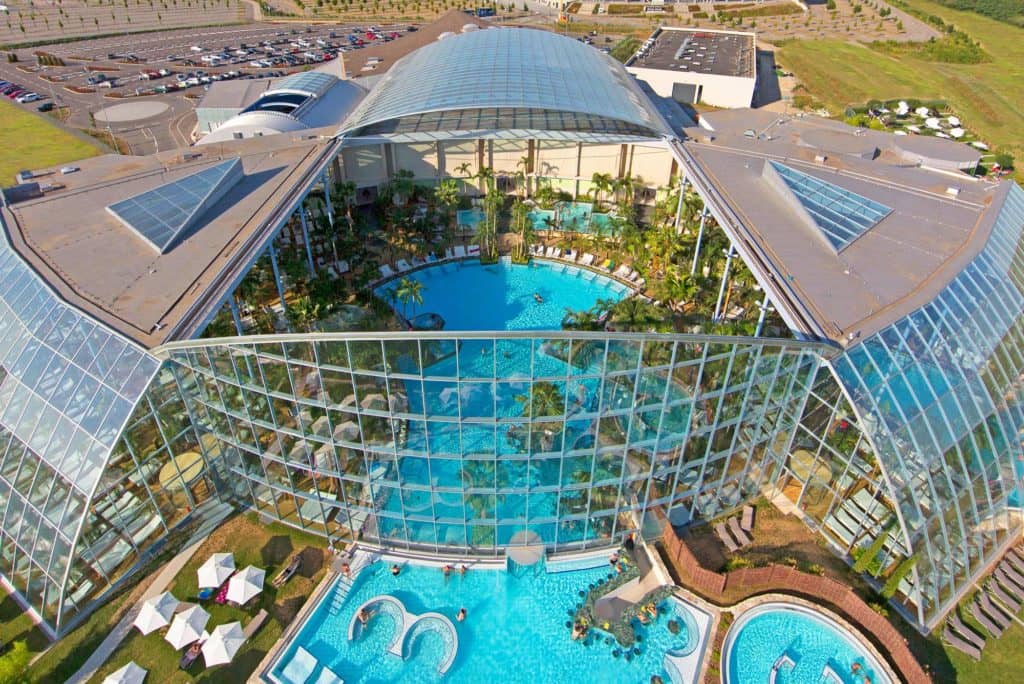
The Thermen & Badewelt Sinsheim resort in Sinsheim, Baden-Württemberg, covers approximately 164,000 m². It opened on 19 December 2012 and is estimated to have cost around €50 million to build. The complex is divided into three main zones:
- Palmenparadies—a tropical palm paradise with more than 400 real palm trees, a crystal-blue lagoon at 34°C, relaxing whirlpools, massage loungers and, in summer, the sandy Paradise Beach.
- Vitaltherme & Sauna—an adults-only, textile-free wellness and sauna world. It offers 13 themed saunas, including the world-famous 166 m² Koi Sauna, listed as the largest sauna in the world. Another attractive new feature is a floating sauna boat that sails on the resort lake.
- Sportbad—classic swimming and sports pools for more active visitors.
Overall, Thermen & Badewelt Sinsheim combines relaxation, an exotic setting and wellness experiences. The tropical style of Palmenparadies contrasts with the traditional sauna culture of Vitaltherme & Sauna, giving guests a choice between peaceful relaxation, sauna bathing and more active swimming.
Accommodation at Thermen & Badewelt Sinsheim: The thermal baths have no hotel of their own. Their closest cooperation is with the four-star Hotel Sinsheim, located by Technik Museum Sinsheim about a two-minute drive from the baths.
9. Toskana Therme Bad Schandau – thermal baths just across the Czech border

If you are looking for German thermal baths really close to the Czech Republic, Toskana Therme Bad Schandau is one of the most interesting options. It lies directly on the Elbe in Saxon Switzerland, just across the border from Hřensko and Děčín. It cannot compete in size with Therme Erding or Bad Füssing’s huge spa complexes, but its facilities are much more varied than the exterior suggests.
The water area includes an indoor swimming pool with two 25-metre lanes, an outdoor pool, current channel, children’s pool with a small slide, whirlpool and separate warm pool. The pools have massage jets, while outdoor bathing opens up attractive views of the surrounding Elbe valley and sandstone rocks.
The greatest speciality, however, is the Liquid Sound Tempel. This is a thermal saltwater pool combining warm water with music transmitted beneath the surface, coloured lighting and image projections onto a 360-degree dome above the pool. It is not simply a whirlpool with background music—the sound is also perceived underwater, and the description “bathing with all the senses” really makes sense here. Special music evenings and concerts in the water are also held here.
The sauna area is surprisingly good too. It contains five different types of sauna and warming room: the gentler Laconium at around 55°C, Zisterne and Kräuterbad at around 65°C, the classic Schwitzstube heated to approximately 96°C, and a panoramic sauna at around 90°C with views towards the Elbe. A cold plunge pool, Kneipp path, experience showers and ice fountain provide cooling.
Accommodation at Toskana Therme Bad Schandau: The most logical choice is the 207-room Hotel Elbresidenz an der Therme, which, like Toskana Therme, belongs to the Toskanaworld group. The baths are about 200 metres from the hotel, and guests receive unlimited admission to both the pool and sauna areas. The hotel itself also has the Aurorabad with a pool, saunas and panoramic views of Saxon Switzerland.
10. Soletherme Bad Elster – exceptionally salty water near the Czech border

Soletherme Bad Elster is a completely different kind of thermal spa from the large family aquaparks. You will not find dozens of pools or a tower of water slides. Its main attraction is exceptionally concentrated thermal brine, which lets you float almost effortlessly in some pools. Bad Elster is also very easy to reach for visitors from western Bohemia, lying only a short distance from Aš.
The thermal brine is drawn from approximately 1,200 metres underground, reaches the surface at around 42°C and in its original form has a salt concentration of about 22%. It is, of course, adjusted for the individual pools. These different concentrations are precisely the most interesting feature of the facilities.
The greatest buoyancy is offered by the Salzsee, with 15% brine at approximately 32°C. Because of the high concentration, visits are limited to around 15–20 minutes. Another highlight is the Licht- und Klangbad, with 10% brine at 33–35°C, where floating is accompanied by underwater sound, lighting effects and 20-minute audiovisual programmes. The gentlest is the Vogtland Hutzn-Bad, with about 6% brine at 33–35°C, massage jets and seating. Unlike the most concentrated pool, you can remain in it considerably longer.
A separate sauna world adjoins the thermal baths. Interesting options include the salt sauna at 45°C, the gentle Musikwinkel sauna at 50–60°C, a panoramic sauna at 80–90°C and the hottest Moosmann sauna, which reaches approximately 85–95°C. The site also includes the outdoor “Heiße Elster,” a shallow thermal pool maintained at 38°C.
I would recommend Bad Elster mainly to those seeking genuinely unusual mineral water and quieter wellness. Children under 14 are not allowed into Soletherme, so the atmosphere is noticeably calmer than at family thermal resorts.
Accommodation at Soletherme Bad Elster: The four-star superior Hotel König Albert has the best location. Its 108 rooms and suites are connected to Soletherme, the sauna world and historic Albert Bad by a covered bathrobe corridor, allowing you to reach the thermal water from your room without changing or going outside.
11. Siebenquell GesundZeitResort – 1,500 m² of thermal water and a 6,800 m² sauna world

If I had to choose a resort with the most comprehensive facilities, Siebenquell GesundZeitResort in Weißenstadt would rank very highly. These thermal baths in the Fichtel Mountains combine classic thermal pools, an enormous sauna world, seven special mineral baths, wellness, therapy, fitness and a hotel directly in the resort.
In total, there are approximately 1,500 m² of thermal water. More than 1,000 m² forms the continuous water area of the main Wasserwelt, including a large active thermal pool, relaxation pools with massage jets and loungers, a current channel, whirlpool, hot pool, two outdoor pools and even a pool bar. Families are catered for too, with a separate area for small children.
The thermal water comes from a borehole almost 2,000 metres deep and contains, among other things, high levels of fluoride. Temperatures in the main pools are generally around 32–34°C, while the separate hot pool is approximately 38°C.
The sauna section is even more impressive. It covers approximately 6,800 m² and contains eight themed and experience saunas, one steam sauna, an infrared cabin and a snow chamber. The temperature range is enormous, from about −10°C in the snow room to 95°C in the hottest sauna. It also includes an outdoor sauna village, lake, relaxation house and extensive quiet areas.
GesundZeitReise is a chapter in itself, with seven mineral baths inspired by historic spa cultures. The resort is complemented by more than 1,400 m² of therapy facilities and a fitness centre covering over 600 m².
Accommodation at Siebenquell: You do not need to look anywhere outside the complex. Siebenquell GesundZeitResort includes its own four-star superior thermal hotel with 124 rooms and 224 beds. There is direct access from the hotel to the thermal baths, and the room rate includes use of Wasserwelt, the extensive sauna world and the resort’s other main areas.
12. Rottal Terme Bad Birnbach – over 30 thermal pools and 2,400 m² of healing water

Rottal Terme in Bad Birnbach is one of those places that does not look as gigantic as Therme Erding in photographs, but the numbers are actually impressive. The complex offers more than 2,400 m² of healing thermal water and over 30 indoor and outdoor thermal pools. If you mainly want plenty of warm water and a large selection of pools without aquapark noise, Bad Birnbach is a very strong choice.
Pool temperatures range approximately from 26 to 40°C, allowing you to alternate between cooler swimming and exercise pools and genuinely hot relaxation baths. There are massage jets, bubble loungers, outdoor pools and areas focused on movement therapy and rehabilitation.
The most interesting water attraction is the 105-metre Thermenbach, which functions as a long thermal current channel. Instead of making a few quick laps around a small circle, you let the water carry you along a fairly long route through the outdoor part of the complex.
The sauna world is also well above average. Rottal Terme has 13 saunas and steam baths, so you can easily spend a large part of the day sauna bathing. The complex is designed more as a spa than an entertainment venue: instead of slides, it is dominated by varied water temperatures, relaxation rooms, sauna ceremonies and extensive outdoor areas.
Another interesting number is the approximately 1,072 loungers and resting places available. This shows that the complex is not merely a few pools squeezed into one hall. There are also three food outlets and a therapy section offering physiotherapy, massages and other treatments.
Few spas in Germany offer more than 30 pools with temperatures ranging from 26 to 40°C.
Accommodation at Rottal Terme: One of the most convenient options is the four-star Thermenhotel Hofmark, directly connected to all the main areas of Rottal Terme by an accessible bathrobe corridor. The hotel has approximately 85 rooms.
13. Franken-Therme Bad Windsheim – a 17,500 m² complex with its own “Dead Sea”

Franken-Therme Bad Windsheim covers approximately 17,500 m², and its greatest speciality is not the size itself but the exceptionally high brine concentration. If you enjoy floating and the feeling of being supported by the water, this is one of the most interesting places in all of Germany.
The water area offers approximately 2,000 m², centred on six thermal brine pools at roughly 26–36°C. The salt concentration also changes from pool to pool. In the standard thermal section it starts at around 1.5%, so bathing remains comfortable even for a longer stay.
The greatest experience awaits in the separate Hochsole area. Here are two floating pools with 12% brine, in which the water supports the body very noticeably. One is approximately 36°C and features underwater music with coloured lighting. The highlight, however, is the outdoor salt lake with an incredible concentration of 26.9%, nicknamed the Fränkisches Totes Meer—the Franconian Dead Sea. The water is so dense that you genuinely lie on the surface with almost no effort.
The sauna facilities are strong too. The complex offers eight classic saunas—five indoor and three outdoor—complemented by a separate snow sauna and large sauna garden. The thermal section also includes two steam baths.
Franken-Therme is primarily focused on tranquillity. Standard admission is currently restricted to visitors aged six and over. Do not expect water slides or a noisy aquapark. People come here for the brine, long periods of rest in the water and saunas—and this is exactly what the spa does exceptionally well.
Accommodation at Franken-Therme: Two hotels let you reach the spa without going outdoors. The 91-room Kurhotel Pyramide is linked to Franken-Therme by an underground bathrobe corridor; the more modern, 87-room Vital Hotel an der Therme offers a similar direct connection. If the thermal baths are the main reason for your visit to Bad Windsheim, both are considerably more convenient than a hotel in the town centre.
14. Caracalla Therme Baden-Baden – 5,000 m² of thermal baths and seven saunas
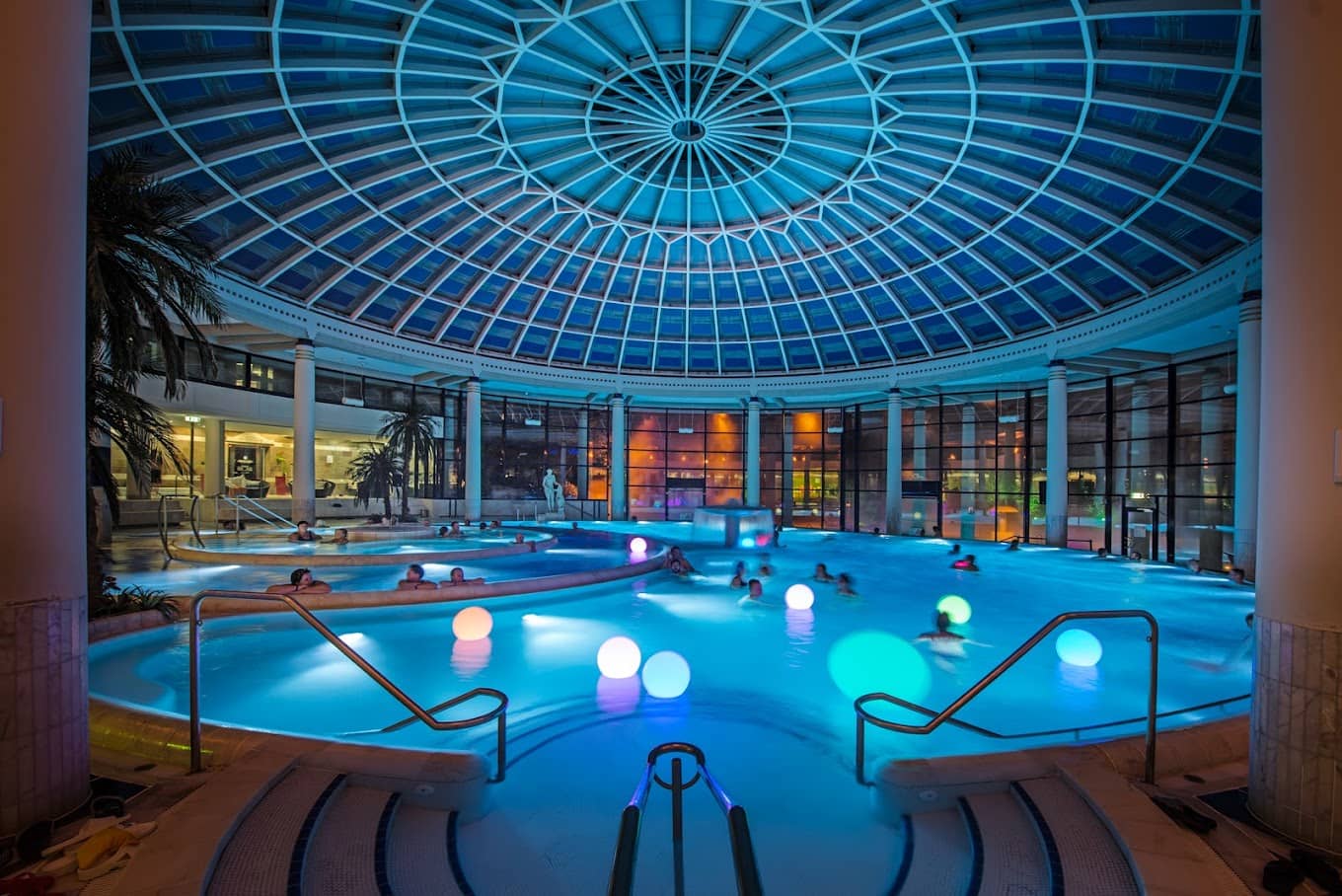
Baden-Baden is one of Europe’s most famous spa towns, and Caracalla Therme is its more modern thermal face. The thermal and relaxation section covers approximately 5,000 m², of which more than 900 m² is water. Depending on the pool, temperatures range from 18 to 38°C, although most thermal pools remain within a pleasant 32–38°C.
The heart of the complex is a large indoor pool beneath a striking dome. This pool alone has 29 different massage jets at several heights, allowing you to massage practically the whole body. Neck cascades, air jets and a bubble section are also included.
Outside are two more large thermal pools. The larger has a current channel, water mushroom, massage features and two whirlpools heated to 38°C. The smaller outdoor pool focuses primarily on hydromassage, with 12 bubble seats, five bubble loungers, five neck showers and four massage jets. If you prefer quietly moving between different massage stations to swimming, this section is very successful.
Another feature is the hot-and-cold grotto, where water at around 38°C alternates with a cold pool at approximately 18°C. An aromatic steam bath and salt inhalation room complement the water area.
Caracalla uses thermal water from local deep springs and continuously replenishes its pools. Approximately 800,000 litres of fresh thermal water flow through the system every day.
If you enjoy saunas, I would definitely choose a combined ticket. The sauna world offers seven saunas, including the panoramic GreatSpa Sauna, themed saunas and outdoor saunas in the garden on the Schlossberg hillside. In classic German style, the sauna section is swimsuit-free.
Accommodation at Caracalla Therme: The most interesting option is Aqua Aurelia Suitenhotel, the only hotel in Baden-Baden with a direct underground passage to Caracalla Therme. It has just 46 spacious suites starting at 35 m², and you can walk from the hotel to the baths in roughly two minutes, wearing your bathrobe.
15. Claudius Therme Cologne – 12 pools, 8 saunas and floating in 15% brine

Claudius Therme in Cologne is no longer a destination for a quick trip across the Czech border, but its facilities unquestionably earn it a place in a Germany-wide selection. The complex lies in the green Rheinpark almost in the city centre, yet feels much more like a spa resort than an urban swimming pool.
There are currently 12 different pools. Alongside the large central pool, you will find indoor and outdoor thermal pools, seated therapeutic pools, whirlpools, a current channel, massage jets, bubble loungers and neck showers. The hot-and-cold grotto is also interesting: its warm section is approximately 35°C, after which you can cool down in cold water.
A separate floating pool offers a completely different experience. Approximately 12 tonnes of Dead Sea salt are added to the water, creating brine with a concentration of about 15%. There is virtually no need to swim in water this salty; you can simply lie on the surface. Music audible underwater forms part of the experience.
If I had to highlight one part of Claudius Therme, however, it would be the sauna. The complex has eight saunas and three steam baths divided among three large areas: the indoor sauna world, a separate sauna village and the Rosenterrassen. You will find classic Finnish saunas, a herbal steam bath, Russian banya, exceptionally hot Erdwallsauna and a panoramic sauna looking towards Cologne Cathedral.
The sauna programme is fairly intensive, with up to 24 ceremonies and infusions held during the day. The sauna section itself also has three pools and further relaxation areas, so combining the thermal baths and saunas can easily fill an entire day.
Claudius Therme belongs in this guide mainly as an example of the German urban thermal-spa model: it is not an aquapark, but a combination of healing thermal water, a large number of pools and truly refined sauna culture. Thanks to its Rheinpark location, Cologne city centre is also quite literally just around the corner.
Accommodation at Claudius Therme: Claudius Therme has no hotel of its own, and no hotel is directly connected to the complex.
Is thermal water in Germany healing?
The label “thermal baths” covers very different waters in Germany. Bad Füssing is known for sulphurous thermal water, Bad Elster for exceptionally concentrated brine, Bad Windsheim for salty springs and Baden-Baden for very hot mineral springs rising from great depths.
It is therefore impossible simply to say that every German thermal spa treats the same conditions. Some springs have the status of officially recognised healing water and are used for spa treatment or rehabilitation, while other complexes focus mainly on wellness and recreational bathing. Specific effects and possible contraindications always depend on the water’s composition, its temperature, the length of exposure and the visitor’s state of health.
If you are visiting thermal baths primarily because of health problems rather than simply for relaxation, I would choose according to the particular spring and the spa’s treatment indications, not merely the number of pools and saunas.
Map of thermal baths in Germany
Thermal baths in Germany connected to a hotel
If I am going to thermal baths for an entire weekend, a hotel directly by the spa personally makes much more sense to me than accommodation several kilometres away. The ideal solution is the German concept of a Bademantelgang: a covered or heated corridor allowing you to walk from your hotel room straight to the thermal baths in your bathrobe.
Germany has several such places. At large thermal resorts, however, it is worth distinguishing between a hotel “beside the spa” and one genuinely connected directly to the complex.
- Hotel Victory Therme Erding—If you want to combine Therme Erding’s enormous water world with an overnight stay, Hotel Victory, standing directly inside the complex, is the simplest choice. Hotel guests can enter the spa directly from the building, so there is no need to go outside or drive anywhere after bathing.
- Siebenquell GesundZeitResort Weißenstadt—Siebenquell is even more compact. The four-star superior hotel, thermal Wasserwelt, saunas, health and wellness section form a single resort. Hotel stays commonly include use of the thermal baths and saunas, so you can spend most of the weekend practically in your bathrobe.
- Hotel Drei Quellen Therme—A very practical connection is also available in Bad Griesbach. Hotel Drei Quellen Therme is linked to Wohlfühl-Therme by a heated underground corridor. For a winter wellness break, this is considerably more pleasant than changing clothes, putting on a coat and walking outside to the baths.
- Hotel an der Therme Bad Sulza—Another genuine Bademantelgang can be found in Bad Sulza. Hotel an der Therme is directly connected to Toskana Therme, and selected stays include unlimited use of the thermal baths, Liquid Sound and the sauna world.
Tip: If you want thermal water directly in your hotel, Bad Füssing is another interesting alternative. Some local hotels draw their own thermal water and have private thermal pools, so you do not need to leave the hotel to bathe.
How German thermal baths work: swimwear, saunas and children
A first visit to German thermal baths can be slightly surprising for a Czech visitor. Swimwear is normally worn in the pool area, but the rules often change completely when you enter a classic sauna world. German sauna culture is traditionally swimsuit-free, and in many complexes the sauna is marked textilfrei.
This does not mean you have to walk around naked everywhere. A towel or bathrobe is normally used when moving between facilities, and you naturally cover up in restaurants and relaxation areas. In a classic German sauna cabin, however, swimwear is generally not worn, and the whole body, including the feet, should remain on the towel while you sit or lie down.
Rules vary from one complex to another, so it is wise to check them before travelling. Therme Erding, for example, has a separate swimsuit-free sauna section for visitors aged 16 and over, while children may enter the pool and water-slide world.
German thermal baths with children? Always check the age limit
The differences are even greater where children are concerned. Some thermal baths operate as family water worlds, while others deliberately protect a tranquil atmosphere and impose an age limit.
Therme Erding is also suitable for families, and water slides and attractions make up a large part of the complex. Siebenquell even has its own area for small children. By contrast, Soletherme Bad Elster is restricted to visitors aged 14 and over because of its highly concentrated brine, while much of Therme Bad Wörishofen normally operates with a minimum age of 16.
I would not underestimate these age restrictions before travelling. In Germany, thermal baths are not automatically synonymous with a family aquapark, and some resorts do not allow small children into the main wellness section at all.


